
The fees you see from a financial planner in Australia are not just a cost; they can be considered an investment in professional expertise. Think of it as paying for a clear, well-constructed roadmap to navigate the complexities of superannuation, investments, and retirement.
Why financial planners charge for their expertise
Hiring a financial planner can be compared to engaging an architect to design a home. You would not likely attempt to build such a significant structure without a detailed blueprint, and a similar logic can be applied when building a secure financial future.
The fees you pay are for professional skill, strategic thinking, and diligent oversight. This covers the considerable time and deep expertise needed to properly understand your unique circumstances, goals, and concerns. It is about receiving a detailed, compliant, and personalised strategy to guide you through significant financial decisions.
What are you paying for?
So, what is actually behind the price tag? The value a planner provides generally breaks down into three key areas.
Professional expertise and qualifications: Financial planners undergo years of education and are required to maintain continuous professional development. This ensures they are on top of complex regulations, changing tax laws, and investment markets. Their fees reflect this deep, specialised knowledge.
Personalised strategy development: A financial plan should not be a generic document. It generally involves a deep dive into your superannuation, assets, income, and goals to build a customised blueprint. This process may take a lot of time for research, modelling different scenarios, and documenting everything in a formal statement of advice.
Ongoing management and support: Your life does not stand still, and neither should your financial plan. Things change—market shifts, new laws, or significant life events can all have an impact. Ongoing service fees often cover regular reviews, portfolio adjustments, and the peace of mind that may come with knowing an expert is looking after your plan.
Understanding these costs is the first step toward making a confident and informed decision. The goal is not just to pay for a service, but to invest in clarity, professional guidance, and a structured approach to achieving your retirement goals.
Ultimately, the fees are for building and maintaining a financial framework designed specifically for you. Once you understand what the fees represent, you can better judge the value of professional advice and see how it aligns with your need for long-term security and confidence.
How financial planners structure their fees
Understanding financial planner fees can sometimes feel complex, but it is often simpler than it looks. Most financial advice practices in Australia use one of a few common methods to charge for their time and expertise. Once you know what they are, you will be in a much better position to have a clear conversation with any adviser you meet.
Each fee model is built to cover different parts of your journey together—from crafting your initial financial roadmap to providing the support needed to keep you on track. Let’s break them down.
Upfront fees for your financial plan
The first fee you will almost always come across is for creating your initial financial plan. This is a detailed, formal document called a statement of advice (SOA), and it acts as the blueprint for your financial future.
This one-off fee covers the significant work that goes into building a strategy for you. It generally includes:
- Getting to know your personal situation, life goals, and how you feel about investment risk.
- Reviewing your existing superannuation, investments, and insurance policies to see what is working and what is not.
- Running the numbers on different scenarios to find suitable strategies to help you get where you want to go.
- Putting it all together in a comprehensive, legally compliant advice document that lays out all the recommendations.
You will typically be quoted a fixed dollar amount for this before any work starts, so there are no surprises.
This infographic gives you a quick snapshot of what a financial planner may bring to the table—it's often a blend of deep expertise, smart strategy, and proactive management.
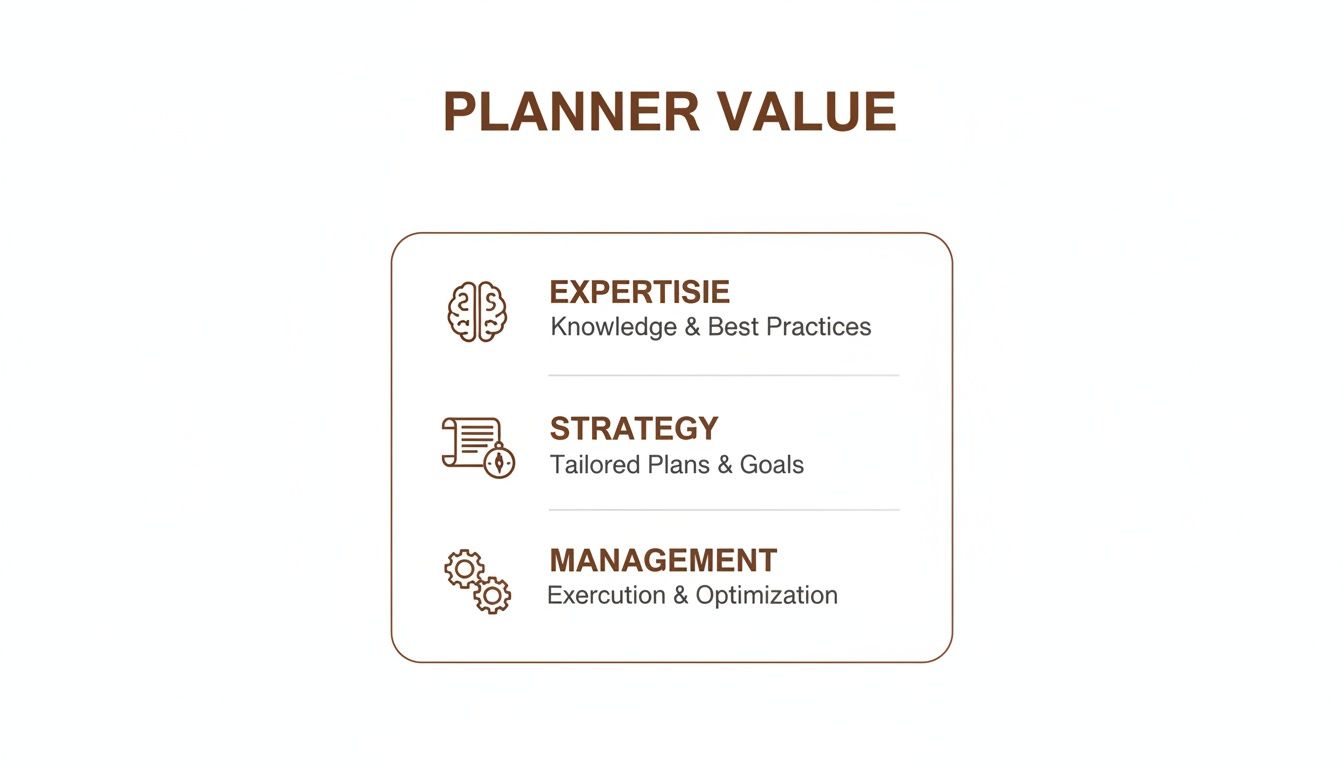
Ultimately, every fee structure is just a different way of paying for these three core elements.
The different fee models
To make it even clearer, here is a quick comparison of the most common ways advisers charge for their services.
Common financial adviser fee models explained
| Fee Model | How It Works | What It Generally Covers |
|---|---|---|
| Fixed Annual Fee | You pay a set dollar amount each year, often billed monthly or quarterly. The fee is agreed upon upfront. | Ongoing services like regular reviews, portfolio adjustments, access to your adviser, and strategic guidance. |
| Asset-Based Fee | The fee is a percentage of the total funds the adviser manages for you (e.g., 1% of your portfolio value). | Typically covers ongoing investment management and reviews. The fee amount rises and falls with your portfolio's value. |
| Hourly Rate | You pay for the adviser's time, just like you might for a lawyer or accountant. | Best for one-off, specific tasks like a superannuation review or a second opinion on an investment, not comprehensive planning. |
Each model has its place, but it's important to understand how they align with the kind of service and relationship you're looking for.
Ongoing service fees
Once your plan is set up, life happens. Markets shift, your goals may change, and your strategy may need to adapt. That is where an ongoing service arrangement comes in. This is usually charged as a fixed annual or monthly fee.
Think of it as having an expert on retainer. This ongoing relationship typically includes regular progress check-ins, portfolio adjustments, and being able to ask your adviser questions when you need to. It is about having the peace of mind that someone is actively watching over your plan for the long haul.
This fixed-fee model gives you certainty. You know exactly what you will pay for the year ahead, regardless of how your investments perform. It may help to keep the adviser focused on giving you consistent, high-quality strategic guidance.
Asset-based fees
Another common model is the asset-based fee. Here, the charge is calculated as a percentage of the total money the adviser is managing for you. For instance, an adviser might charge 1% per year on your investment portfolio.
If you have $500,000 being managed, the annual fee would be $5,000. If your portfolio grows to $600,000, your fee may increase to $6,000, even if the work involved for the adviser has not changed. This model was once the industry standard, but it directly ties the adviser’s income to the size of your portfolio, not necessarily the complexity of the advice.
Hourly rates for specific tasks
While it is less common for building a complete financial strategy, some planners do offer their services at an hourly rate. This approach may work well for very specific, one-off tasks where the scope of work is tight and clearly defined.
You might engage a planner for a couple of hours to sort out a superannuation question or to get a second opinion on an investment decision, without committing to a full financial plan. It can be an option if you just need targeted advice on a single issue.
It is worth noting that the cost of advice has been rising, largely due to tighter regulations and higher compliance burdens. In 2024, the median ongoing advice fee in Australia reached $4,668 per year, which was an 18% jump from the year before. If you are heading toward retirement, it may be useful to budget for these costs, which cover services like annual reviews and strategy adjustments. You can find more details in this analysis of financial adviser fees.
Typical costs for financial advice in Australia
When you start looking for a financial planner, one of the first questions on your mind is probably, "What is this actually going to cost me?" It is a fair question, and while the fees can vary quite a bit across Australia, getting a handle on the typical ranges gives you a solid starting point.
The cost is not just a number. It often comes down to how complex your financial life is and what you need help with. For example, someone with a single superannuation fund and simple goals will likely have a different price tag than a couple juggling investment properties, a business, and complex retirement income streams.
What does an initial financial plan cost?
For that first comprehensive piece of work—the financial plan, which is formally called a statement of advice (SOA)—you are usually looking at a one-off fee. This fee covers all the work upfront: the deep dive into your finances, the research, the strategy sessions, and putting it all together in a clear, actionable document.
Based on recent industry data, an initial SOA could land somewhere between $3,500 and $6,000. Of course, if your situation is particularly complex, it could be higher. This fee pays for the planner's expertise and the significant time they spend crafting a strategy for you.
What about ongoing advice fees?
Financial advice is rarely a "set and forget" arrangement. Life happens. Your goals might shift, markets will change, and rules and regulations are always being updated. That is why many people choose to keep their planner on retainer for ongoing support, making sure their plan stays relevant and on track.
This ongoing service is usually paid as a fixed annual fee, often broken down into monthly or quarterly payments. It provides regular check-ins, portfolio adjustments when needed, and direct access to your planner for any questions that pop up during the year.
The median annual fee for ongoing advice in Australia now sits at around $4,668. This number reflects the growing professional and compliance workload planners manage to provide continuous guidance.
This ongoing investment is what keeps your financial strategy alive and working for you, adapting as you move towards and through retirement.
Factors that influence the cost
So, what pushes the price up or down? A few key things will influence the final quote you receive. Knowing what they are helps you understand why one person’s fees might look different from another’s.
- Complexity of your situation: Are you dealing with multiple superannuation accounts, a self-managed super fund (SMSF), a family trust, or business interests? The more moving parts, the more time and skill are generally needed.
- Scope of advice: Are you after a full retirement plan that covers everything from investments and superannuation to your estate? Or do you just need help with one specific issue? A wider scope naturally means a higher fee in many cases.
- Level of service: How often do you want to meet? How detailed do you want your reports to be? The level of proactive support you expect from your adviser is also built into the ongoing service fee.
The demand for financial advice has grown, especially for help with superannuation, retirement planning, and investing. As the industry has professionalised and compliance has become stricter, the value of independent, expert guidance has become clearer. You can learn more about the trends shaping financial advice fees in Australia.
At the end of the day, having a clear picture of these typical costs means you can walk into a meeting with a potential planner feeling prepared. You will be able to compare quotes, ask the right questions, and properly understand the investment you're making in your financial future.
How fees can impact your retirement savings over time
It is one thing to know what fees a financial planner charges, but it is another to see what those costs may do to your money over the long term. A seemingly small percentage can take a significant portion out of your retirement savings over the decades. This may be due to the effect of compounding.
When your investments grow, those earnings are added to your original amount of money. The next year, you earn returns on your initial capital and on those accumulated gains. That is compounding, and it is a key principle for building wealth over time.
However, compounding can work in reverse, too. Just as your returns compound, so can the fees you pay. A fee taken from your account each year does not just lower your balance for that year; it also reduces the amount of money left to grow in the future.
A simple look at the long-term impact
Let's use a simplified, general example to see how this can play out.
Imagine two people, Alex and Ben. Both start with a $500,000 retirement portfolio and we will assume they both earn a 7% average annual return over 25 years (before fees). This is a hypothetical scenario for educational purposes only and is not indicative of actual returns.
Here is the difference:
- Alex pays a 1.5% asset-based fee every year for financial advice.
- Ben pays a flat annual fee of $5,000 for similar services.
After 25 years, the gap between their final balances could be significant.
Alex’s portfolio, reduced by the 1.5% fee year after year, might grow to around $1.7 million. A significant portion of the potential growth has been reduced by fees.
Ben, on the other hand, could see his portfolio grow to over $2.3 million. The difference is considerable. Even though Ben paid for advice every single year, his fixed fee had a smaller impact because it did not grow as his portfolio did.
This simple example shows a powerful concept: a percentage-based fee gets more expensive as your assets grow, while a flat fee stays predictable, letting more of your money keep working for you. This example is for illustrative purposes and does not represent a guarantee of future performance.
Why this is important for your retirement
The effect of high fees becomes most impactful over long periods, which is why it is critical for anyone planning for retirement. Over 20 or 30 years, a small difference in annual fees could potentially cost you tens, or even hundreds, of thousands of dollars from your final nest egg.
This is not to say that the cheapest advice is always the best. The expertise, strategy, and peace of mind a good adviser brings can be invaluable. However, it does mean that the way you pay for that advice is just as important as the dollar amount.
Knowing this empowers you to ask smarter questions and make better choices. A transparent, flat-fee model gives you certainty and may help ensure the advice is focused on your goals, not on the size of your account balance. When you are building a plan for the rest of your life, it is wise to look at the total cost of advice over the entire journey.
If you are keen to explore the building blocks of a solid retirement, you might find our article on understanding your superannuation through planning a helpful next step. It is a good primer on how proactive planning can make a difference.
Why independent, commission-free advice matters
How a financial planner is paid is more than just a line item on an invoice—it can be a reflection of their professional obligations. Understanding their fee structure is one of the most important things you can do, because it has a large impact on the advice you may receive.
When an adviser’s income is tied to recommending a specific product, a conflict of interest can arise. Are they recommending that fund because it is suitable for you, or because it pays them a commission?
This is why independent, commission-free advice is considered a high standard. It creates a transparent relationship where the adviser’s interests are aligned with yours. You pay them for their time and expertise, and that is it. No commissions or other incentives from product providers.

What "truly independent" really means
In Australia, the word "independent" is not just a marketing slogan; it is a legally defined term. For a financial adviser to call themselves truly independent, they must meet specific legal requirements. A key one is that they cannot accept any commissions or asset-based fees.
This structure is designed to completely remove the influence of product providers. An independent adviser’s recommendations are based purely on what is appropriate for your situation and your goals, not on what might earn them a payment from a bank or insurance company.
However, genuine independence is rare. The vast majority of financial advisers in Australia are not legally permitted to use the "independent" label because their business model may still rely on some form of commission or they are tied to a larger financial institution.
The issue with "conflicted remuneration"
Commissions and other incentives paid by product manufacturers are known in the industry as conflicted remuneration. These payments were a major focus of the Banking Royal Commission, which uncovered examples of how they led to advice that put the adviser's interests ahead of the client's wellbeing.
While the industry has changed significantly since then, some commissions are still permitted—especially on certain life insurance products. To see how this can play out, check out our guide on insurance advice with or without commissions. It is critical to know exactly how an adviser is paid for insurance recommendations to be sure the advice is objective.
An adviser who works on a commission-free, no asset-based fee basis has a simple and transparent structure. Their duty is to you, the client, because you are their only source of payment. This straightforward relationship helps build trust and ensures the focus remains on your financial success.
Tying your adviser's success to your own
When you choose a commission-free adviser, you are ensuring their professional success is linked to yours. Their goal is to give you sound, strategic guidance that helps you work towards your long-term targets. Their reputation and their business rely on satisfied clients, not on meeting sales quotas.
This becomes even more important as your financial life gets more complex, particularly as you approach and move into retirement. The financial planning landscape in Australia has shifted, with a much bigger focus now on delivering high-value, specialised advice to people with more sophisticated needs.
Ultimately, engaging a truly independent adviser means you are investing in a professional partnership built on trust. You can be confident that every piece of advice you receive is given with your best interests at heart, free from the influence of sales targets or hidden incentives.
Questions to ask a financial planner about their fees
Walking into your first meeting with a potential financial planner can feel a little daunting. Being armed with the right questions can help you cut through the noise, helping you see past the price tag to understand the value and transparency on offer.
The goal here is simple: find an adviser who is happy to talk openly about how they get paid. A planner who is confident in the value they provide will generally have no problem giving you straight, simple answers.
Key questions about fee structure
Before you agree to any services, you should know exactly how an adviser makes their money. This is the only way to be sure their interests are truly aligned with yours.
Here are a few essential questions to ask in that first chat:
- How are you paid? Get them to explain it clearly. Is it a fixed fee, a percentage of your assets, an hourly rate, commissions, or a mix of these?
- Are you legally defined as an independent financial adviser? This is a crucial question. It tells you whether they accept commissions or have financial ties to the companies whose products they might recommend.
- Could you give me a full breakdown of all potential fees? Ask for a complete list of costs – from the initial plan and implementation to any ongoing service fees. There should be no surprises later.
- How will you report the total fees to me over time? Good advisers are transparent. You should know exactly how and when you will be updated on what you are paying.
- What specific services does your ongoing fee cover? Make sure you understand what you are getting for your money. How many meetings per year? What kind of support can you expect between reviews?
Asking these direct questions puts you in control. For more tips on finding the right professional for you, check out our guide on how to choose a financial adviser.
At the end of the day, the right adviser is someone who makes you feel confident and in control of your financial future. The best way to find out if professional advice is a good fit is to start the conversation and get guidance that is built around your personal situation.
Your top questions about financial planner fees answered
Thinking about getting financial advice often comes with a lot of questions, especially around the costs. It is completely normal to wonder what you are paying for and why. Let's clear up some of the most common queries so you can move forward with confidence.
Are financial planner fees tax deductible in Australia?
Yes, in many cases they are. Generally, if the advice is about managing investments that produce income for you, those ongoing advice fees can often be claimed as a tax deduction.
However, it is not always that simple. The initial cost to put together your very first financial plan is usually considered a capital expense, so that part is not typically deductible. Tax rules have their own complexities, so it is always a good idea to speak with your accountant to be sure about what applies to your specific situation.
Is it better to pay a fixed fee or a percentage-based fee?
This often comes down to what you are most comfortable with. A fixed fee (or flat fee) gives you complete clarity. You know exactly what you are paying from day one, with no surprises, regardless of how your investments perform.
On the other hand, a percentage-based fee is tied to the total value of your assets. As your wealth grows, so does the fee you pay. Over time, this can add up. Many people find a fixed fee feels more aligned with their interests, as the focus stays on quality advice, not just on growing the assets to increase the fee.
How often should I expect to pay for financial advice?
The timing of payments usually lines up with the service you are receiving. It typically breaks down into two parts.
- An upfront fee: This is a one-time cost for the work involved in creating your comprehensive financial plan, often called a statement of advice.
- An ongoing service fee: If you decide you want ongoing support, this fee covers regular check-ins and adjustments to your plan. It is usually an annual fee, but most people pay it monthly or quarterly for convenience.
Can I negotiate fees with a financial planner?
It may be possible to discuss fees. While many advisers have set fee structures, there can be some flexibility depending on the circumstances. The conversation should not just be about price, though—it should also be about value.
If your needs are quite straightforward, you could see if a more streamlined service is available for a lower cost. A good adviser will be happy to walk you through their fees, explain exactly what you get for your money, and make sure you are completely comfortable before you proceed.
The information on this page is for general purposes only and does not constitute personal financial advice. Before making any financial decisions, you should seek professional advice from a qualified financial planner.
At VTA Financial Planning, we believe in simplicity. Our advice is commission-free and we do not charge asset-based fees, so our guidance is transparent and focused on what is best for you. If you would like to see if our approach fits your needs, we would be happy to chat in a complimentary initial consultation.